

What Is Local SEO? Can You DIY It in 2026?
Local SEO makes a business show up in location-based search results on Google Search, Google Maps, and other search engines. For plumbers and other service businesses, it’s the difference between getting found by local homeowners who need help right now—or being invisible to the folks most likely to call.
In 2026, local search engine optimization feels more competitive than ever. But it’s also more accessible to small business owners willing to put in steady effort.

Short answer? Yep, a plumber or small business owner can handle a lot of local SEO tasks without hiring an agency. But if the competition is tough or the service area gets big, DIY starts to hit its ceiling fast.
This guide breaks down how local search works, what a strong local presence really needs, which tasks are realistic to do yourself, and where bringing in a pro makes sense. Plumbing businesses are the main example here, since they rely so much on phone calls, booked jobs, and Google Maps visibility.
Whether you’re claiming and optimizing a Google Business Profile, building consistent citations, chasing more Google reviews, or just figuring out which SEO tools are worth the money, the info here should help business owners decide what’s doable in-house—and when it’s time to call in a specialist.
If you’re ready to skip the DIY and talk to a local SEO team, SEO My Website Guru works with small businesses in Brazoria County and beyond. They’re at (979) 487-3296 or seomywebsite.guru.
Key Takeaways
- Local SEO helps plumbers and service businesses show up in Google Maps and local search results when nearby customers are looking for help.
- Business owners can handle basics like Google Business Profile setup, review management, and simple on-page SEO. But advanced strategy usually needs professional support.
- If you want to measure real ROI, track phone calls, booked jobs, and revenue—not just rankings or website traffic.
How Local Search Works for Plumbers
Local search results are the listings Google shows when it thinks someone’s looking for a product or service nearby. For plumbers, searches like "plumber near me," "emergency drain repair," or "water heater installation in Lake Jackson" trigger results tailored to the searcher’s location.
Google uses a mix of the local pack (map results), organic search results, and sometimes those new AI overviews to answer these queries.
The Difference Between the Local Pack and Organic Results
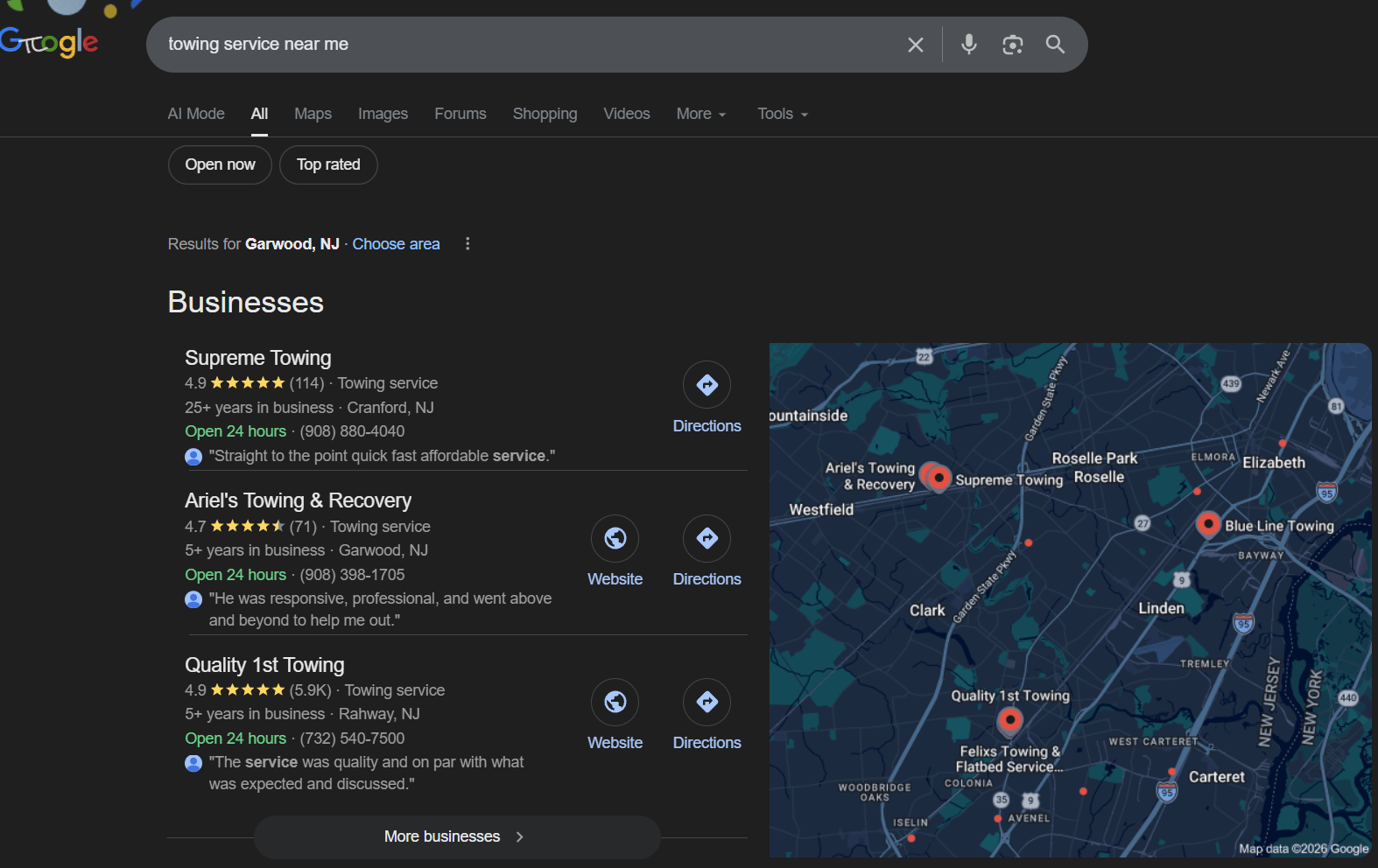
The local pack—or map pack—is the group of three business listings at the top of Google search results, right next to a Google Maps snippet. These listings pull from Google Business Profile data and show the business name, reviews, phone number, hours, and a link for directions.
For plumbers, showing up in the local pack is where most phone calls come from. Organic results are the traditional blue-link listings below the map pack. Those pull from website content, not GBP data.
A plumbing company can show up in both the local pack and organic results, but each needs a different approach. As Semrush explains, local SEO can help both a Google Business Profile’s map pack placement and a website’s standard search rankings.
How Google Uses Relevance, Distance, and Prominence
Google ranks local results using three main factors:
- Relevance: How closely a business matches what the searcher wants. Picking the right business category and writing detailed service descriptions on a GBP listing helps here.
- Distance: How far the business is from the searcher. You can’t control the map, but you can set service areas and create location-specific landing pages.
- Prominence: How well-known and trusted the business looks online. Reviews, citations, backlinks, and your overall web presence all play a part.
Why "Near Me" Searches Turn Into High-Intent Leads
If someone searches "plumber near me" at 10 p.m. on a Tuesday, they’re not just browsing. They probably have a broken pipe or a clogged drain and need help fast.
LocaliQ’s 2026 local SEO checklist says almost 80% of smartphone searches for local businesses lead to an offline purchase. These searches show local intent at its peak, and businesses that rank for them consistently get more calls, direction requests, and booked jobs.
Local visibility in Google Maps and the local pack often means more foot traffic and phone calls for service-area businesses. Plumbers who ignore local rankings are leaving real money on the table.
What a Strong Local Presence Actually Includes

A strong local presence is more than just a website. It’s about an optimized Google Business Profile, consistent business info across directories, an active review strategy, and landing pages that match the services and cities a plumber really serves.
Google Business Profile Setup, Categories, and Service Area Signals
The Google Business Profile is the single most important asset for local pack visibility. Setting it up right means verifying your business, picking the right primary business category (like "Plumber"), and adding secondary categories for actual services ("Water Heater Installation Service," "Drain Cleaning Service," etc.).
For service-area businesses (SABs) like plumbers who travel to customers, setting the service area tells Google which cities and zip codes you cover. Fill out photos, posts, service descriptions, and business hours—keep it all up to date.
DataPins points out that helping a GBP rank higher in the Google Maps 3-Pack is the classic example of local SEO for plumbers.
NAP Consistency Across Business Listings and Directories
NAP stands for Name, Address, and Phone number. Every online mention—on Yelp, Yellow Pages, Apple Maps, Bing Places, Facebook, Foursquare, or industry directories—should show the exact same NAP info.
Inconsistencies confuse Google and reduce trust. Even little things like "St." versus "Street" or a missing suite number can mess up local citations. Data aggregators send info to hundreds of directories, so errors multiply fast.
Auditing and fixing business listings across directories is a foundational task that pays off over time.
Reviews, Review Management, and How to Respond to Reviews
Google reviews directly impact local rankings and customer decisions. A plumbing business with 80 recent, positive reviews will beat one with just 12—both in the local pack and in the eyes of potential customers.
Review management means:
- Asking happy customers for reviews after every job
- Replying to every review, good or bad, quickly and professionally
- Watching your reputation across Google, Yelp, and other platforms
Replying to reviews tells Google you’re active and engaged. It also builds trust with future customers reading those reviews. Businesses like SEO My Website Guru often include reputation management in their local SEO service because it has such a direct impact on rankings and reputation.
Location Pages, Service Pages, and Conversion-Focused Landing Pages
If a plumber serves six cities, they need more than just a homepage. Each city and each main service should get its own page with unique, relevant content. These location-specific landing pages help Google connect the business to searches in those areas.
Effective landing pages include:
- A clear headline with the service and city name
- A service description tailored to the local area
- A strong call to action (phone number, contact form, or booking widget)
- Schema markup to help search engines understand the page
- Internal links to related service and location pages
These pages aren’t just for rankings—they’re built to turn visitors into phone calls and booked jobs. Google’s knowledge panel often pulls from structured data on these pages, reinforcing your presence in search results.
Can You Do It Yourself or Should You Get Help?
This is the big question for most small business owners. Honestly, it depends on your time, comfort with tech, local competition, and how much you want to grow.
Some parts of local SEO are pretty doable on your own. Others need specialized tools, ongoing monitoring, and strategy experience that most plumbers just don’t have time to learn.
The Tasks Most Owners Can Handle In-House
Several basic local SEO tasks don’t need deep technical know-how:
- Claim and fill out your Google Business Profile with accurate info, photos, and service details
- Ask customers for Google reviews after jobs, and reply to those reviews
- Keep business hours and contact info updated on your website and GBP
- Post updates to your Google Business Profile weekly or every other week
- Make basic website content updates like adding a service or fixing a typo
These tasks take consistency, not expertise. They’re the baseline for any local SEO strategy.
Where DIY Usually Breaks Down
Most DIY efforts hit a wall when you move from setup to ongoing optimization and real competition. Common sticking points include:
- Local keyword research: Figuring out which search terms actually drive calls takes tools like Google Keyword Planner, Semrush, or Ahrefs—and knowing how to use the data.
- Technical SEO and audits: Fixing crawl errors, speeding up pages, adding schema markup, and dealing with Google Search Console issues takes some technical chops.
- Citation management at scale: Auditing and fixing NAP data across dozens of directories by hand is a slog. Tools like BrightLocal, Moz Local, Whitespark, or Semrush Local help, but they cost money and have a learning curve.
- Map rank tracking: A basic rank tracker shows organic positions, but a map rank tracker with geo-grid analysis shows exactly where you rank across your service area. Most owners don’t even know these tools exist.
- Competitor analysis: Figuring out why a competing plumber outranks you means reverse-engineering their backlinks, citations, review patterns, and content strategy.
As WebFX points out, DIY SEO works for the basics, but technical optimization and competitive strategy are where most owners really need professional help.
How to Judge Whether an Agency or Consultant Is Worth It
Not every SEO agency delivers. Plenty of plumbers have been burned before. When you’re shopping for help, look for these signs:
- Transparent reporting: The agency should give you regular access to real data from Google Search Console, GBP insights, and rank tracking dashboards. No fuzzy promises.
- Clear deliverables: What exactly are they doing each month? Ask for a list.
- Local focus: A big national agency might not get the details of local pack optimization, citation building, or service-area business strategy.
- Results guarantees with conditions: Some firms, like SEO My Website Guru, offer a 30-Day Results Guarantee tied to real improvements in visibility, keywords, or GBP actions. That kind of accountability matters.
- No long-term lock-in without proof: Watch out for year-long contracts before you see results.
The right partner should feel like a knowledgeable guide, not a black box that takes your money and sends you vague monthly reports.
The DIY Process Step by Step
If you’re a plumbing business owner ready to take the first steps yourself, here’s a practical process that covers the most impactful activities.
Start With Local Keyword Research and SERP Validation
Before changing anything on a website, you really need to know what potential customers are searching for. Make a list of your core services: drain cleaning, water heater repair, slab leak detection, sewer line replacement.
Then, tack on location modifiers like "drain cleaning in Pearland" or "emergency plumber Angleton." It’s a simple step, but it matters.
Use Google Keyword Planner or just play around with Google Autocomplete to find related terms. Start typing partial queries and check out the suggestions—those are actual searches people in your area are making.
Validate each keyword by searching it in Google and looking at the SERP. See who’s ranking, whether a local pack pops up, and what kind of content holds those top spots.
This gives you a real sense of the competition and what you’re up against.
Fix On-Page SEO Basics on Core Service and City Pages
Every major service page and city page needs a few essentials:
- A unique, keyword-rich title tag(keep it under 60 characters)
- A strong meta description with your service and location
- Logical headers(H1, H2, H3) to break up content
- Clean URLs that include the service or city name
- Good internal linking between related service and location pages
- Structured data(schema markup) for local business, service, and reviews
Your website needs to tell Google what you do and where you do it. Miss these basics, and everything else gets a lot harder.
Build Trust With Citations, Local Backlinks, and Local PR
Citations confirm your business is legit and actually operates where you say you do. Start with the big platforms:
- Google Business Profile
- Yelp
- Bing Places
- Apple Maps
- Yellow Pages
- Industry directories like Angi or HomeAdvisor
Local backlinks from relevant sites make a difference, too. Join your local chamber of commerce, sponsor a community event, or get mentioned in a local news article—these all help build local links.
Ahrefs’ DIY SEO guide says you don’t have to overcomplicate link building, but you do need to be consistent and focus on quality.
Keep Profiles, Photos, Posts, and Business Data Updated
If your Google Business Profile hasn’t been touched in six months, it looks neglected to both Google and customers. Regular activity really matters.
Try posting weekly updates about finished jobs (with before-and-after photos if you can), seasonal tips, or special offers. Upload new photos often.
Update business hours for holidays. If you add a new service, update your GBP and add a new page to your website. Listing management isn’t a one-and-done thing—it’s ongoing.
How to Measure Whether Local SEO Is Paying Off
Tracking results trips up a lot of small business owners. If you’re not measuring, you can’t tell what’s working or where your money’s going.
Rankings That Matter Versus Vanity Metrics
Ranking #1 for a keyword nobody searches? That’s just a vanity metric. What actually matters is showing up in the local pack and organic results for keywords that lead to phone calls and jobs.
Here’s what to track:
- Local pack positions for high-intent keywords like "plumber near me" or "emergency plumber [city name]"
- Map rank positions across your whole service area using a geo-grid map rank tracker
- Google Business Profile actions: calls, direction requests, website clicks
BrightLocal’s guide says the best metrics are the ones that tie directly to revenue, not just visibility.
Using Google Search Console and Analytics to Track Visibility
Google Search Console (GSC) is free and shows which searches bring up your website, how often it appears, and how often people click. For local SEO, GSC lets you see if local keywords are getting more impressions and clicks over time.
Keep an eye on:
- Total impressions and clicks for location-based keywords
- Average position for your main services
- Pages with the most search traffic
- Indexing issues that might block pages from showing up
Google Analytics (GA4) tracks what visitors do after they land on your site—pages visited, time spent, and actions taken. It’s the “what now?” after you get the click.
Connecting Traffic, Calls, and Booked Jobs to ROI
At the end of the day, local SEO should drive revenue—not just traffic or rankings. To make that connection, plumbers need to track:
- Phone calls from Google Business Profile(check GBP insights)
- Form submissions and booking requests from your site
- Which keywords and pages brought in those leads
- How many leads turned into paying jobs
ResultFirst’s analysis points out that businesses tying SEO data to revenue make smarter decisions. Even a basic spreadsheet tracking lead sources and closed jobs can be a game-changer.
What Competent Local SEO Looks Like in 2026
Local SEO isn’t just about claiming a listing anymore. In 2026, a good local search strategy mixes data analysis, competitor research, technical optimization, and a clear understanding of how AI-powered features are changing everything.
Geo-Grid Analysis, Drive-Time Mapping, and Service Area Realism
Your service area isn’t a perfect circle. Highways, traffic, and real demand shape it. Geo-grid analysis uses a map rank tracker to plot local rankings across a grid of GPS points in your area.
This shows exactly where you’re visible—and where you’re not. Drive-time mapping goes further, showing which zones you can realistically serve based on travel time, not just zip codes.
This level of detail helps you decide which areas need their own landing pages and local content. Firms like SEO My Website Guru use these techniques to build hyperlocal strategies that match how people actually search.
Competitor Reverse Engineering and Ongoing Optimization
You can’t ignore your competition. Competitor reverse engineering means analyzing the top-ranking businesses for your target keywords and looking at:
- Their citation profiles and directory listings
- Review count, speed, and average rating
- Backlink sources and local link patterns
- Website content structure and internal links
- Google Business Profile completeness and posting habits
Tools like Semrush, Ahrefs, BrightLocal, and Whitespark make this possible. Rank Tracker’s 2026 analysis points out that ongoing optimization—based on what your competitors are doing—is what keeps you ahead.
SEO isn’t a set-and-forget deal. Weekly reviews, monthly content tweaks, and quarterly strategy shifts keep you in the game.
AI Overviews, Structured Data, and Why Website UX Still Matters
Google’s AI overviews now show up for lots of local searches, pulling info from business profiles, websites, and structured data to give quick answers in search results. Businesses with clean schema markup and organized content are more likely to get featured in these AI summaries.
Structured data helps search engines understand your site’s content in detail. For plumbers, that means LocalBusiness schema, Service schema, Review schema, and FAQ schema. Set these up right, and you improve your odds of showing up in rich results and AI overviews.
Website UX still matters, even in 2026. If your site loads slowly, looks bad on mobile, or hides your phone number, you’ll lose customers—no matter how well you rank.
Ariel Digital Marketing’s 2026 report says businesses that invest in both visibility and user experience always do better. Fast load times, mobile-friendly design, clear calls to action, and a clean site structure aren’t extras. They’re the basics.
Frequently Asked Questions
What steps are involved in improving a business's visibility in local search results?
You’ll want to claim and optimize your Google Business Profile, do local keyword research, build consistent NAP citations across directories, earn and respond to reviews, and create landing pages for each service and location. Keep monitoring and updating content, too.
Which local SEO tasks can a business owner handle without hiring an agency?
Most owners can handle Google Business Profile setup and updates, asking for and replying to reviews, updating hours and contact info, posting weekly updates, and making basic website edits. Technical audits, competitor analysis, and geo-grid tracking usually need pro tools or outside help.
How do Google Business Profile signals influence local rankings?
GBP signals are huge for local pack rankings. Google looks at how complete your profile is, your business category, service area, review count and quality, posting frequency, and photo uploads. Keeping your profile optimized and active really boosts your map pack chances.
What local SEO mistakes most commonly prevent a business from showing up in the map pack?
The big mistakes: picking the wrong primary category, inconsistent NAP info, not asking for or replying to reviews, skipping service or city-specific pages, and leaving your GBP incomplete or inactive. Any of these can tank your local visibility.
How long does it typically take to see measurable results from local SEO efforts?
Most businesses start to see changes in 30 to 90 days, depending on competition and how things look when you start. Early wins usually show up in Search Console as more impressions and clicks for local keywords. In tougher markets, full results can take six months or more.
Which tools and metrics are most useful for tracking local search performance?
Google Search Console gives you a clear look at organic visibility data. Google Business Profile insights can show calls and direction requests.
If you want to see how you stack up in the local pack, a map rank tracker with geo-grid analysis helps. BrightLocal, Whitespark, and Semrush all offer solid local SEO tracking, though each has its quirks.
But honestly, the metrics that really count? Phone calls, form submissions, booked jobs, and revenue. Rankings and traffic numbers are nice, but they’re not the whole story.