

Lake Jackson Texas SEO for Local Business Growth
Why Lake Jackson is a different SEO market than Houston

Lake Jackson Texas SEO for Local Business Growth
Lake Jackson Texas SEO is one of the smartest investments a small business can make when the goal is more calls, more booked jobs, and more local customers walking in. In a market where residents search Google dozens of times a day for plumbers, roofers, dentists, and all sorts of local services, the businesses that pop up in Google Maps and the top organic results are the ones that get chosen.
Search engine optimization built around local intent puts a business in front of people at the exact moment they need help. Timing really is everything here.

For small businesses in Lake Jackson, Angleton, Pearland, Alvin, and the broader Brazoria County area, local SEO is the difference between being found and being invisible. It’s not about chasing traffic from across the country or obsessing over vanity metrics. It’s about making sure your phone rings when someone nearby types "plumber near me" or "AC repair Lake Jackson" into their phone.
The strategies that work in 2026 are more specific, more data-driven, and honestly, more measurable than ever. It’s gotten a bit technical, but that’s where the results start showing up.
This guide breaks down how local search visibility works right now, what ranking foundations actually drive leads, how websites support both map rankings and conversions, and what to look for when choosing the right SEO approach. Whether you’re planning to tackle optimization yourself or thinking about hiring a professional, you’ll find practical details here that actually matter.
If you’re ready to take the next step, you can reach the team at SEO My Website Guru by calling (979) 487-3296 or visiting seomywebsite.guru. They’ll have a straightforward conversation about local growth—no pressure, just real talk.
Key Takeaways
- Local SEO in 2026 depends on Google Business Profile accuracy, citation consistency, review management, and geo-targeted content working together to generate calls and leads.
- A conversion-focused website with fast load times, mobile-first design, structured data, and strong service pages directly supports Google Maps rankings and customer actions.
- Choosing the right SEO strategy means understanding what happens behind the scenes, from geo-grid analysis and competitor research to transparent reporting through real dashboards.
What Local Search Visibility Looks Like in 2026
Local search engine optimization in 2026 rewards businesses that combine accurate business data, strong reputations, and well-built websites. Google's local algorithm still weighs relevance, proximity, and prominence, but the way Google measures those factors has gotten more refined.
The days of stuffing keywords into a listing and hoping for the best are over. Now, it’s about precision and consistency.

How Google Maps, the Map Pack, and Organic Search Work Together
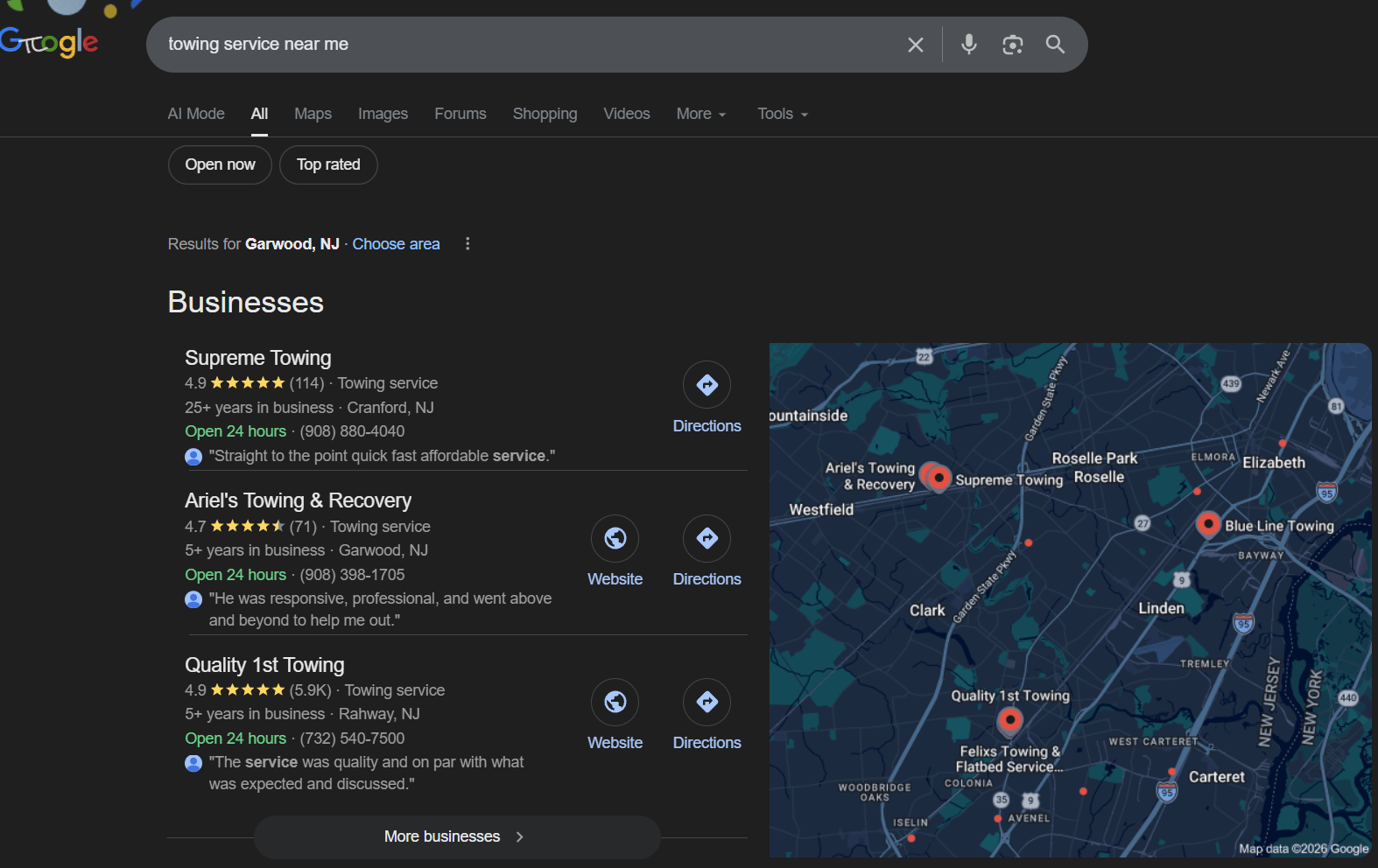
When someone in Lake Jackson searches for a service, Google usually shows three types of results: the Map Pack (top three local listings with a map), organic website results below, and sometimes paid ads above both.
Each of these pulls from different signals, but there’s a lot of overlap. The Map Pack relies on Google Business Profile data, reviews, and local relevance. Organic results lean more on website content, backlinks, and technical SEO.
If your business invests in both its Google Business Profile and its website, you can show up in multiple spots on the same search results page. That’s a huge advantage.
According to recent local SEO statistics , a big chunk of local searches now start directly on map apps. If you haven’t optimized your Google Business Profile, you’re missing out on a whole stream of potential customers.
Why Nearby Intent Matters More Than Raw Traffic
A plumbing company in Lake Jackson doesn’t get much from 10,000 monthly visitors if they all live in Dallas. Local SEO strategy focuses on nearby intent—meaning searches from people physically close enough to become customers.
Searches like "emergency plumber near me" or "water heater repair Lake Jackson TX" show strong purchase intent. These folks aren’t just browsing. They need help now.
Local search intent directly shapes Google Maps rankings. Proximity and relevance to the searcher’s actual location matter more than ever in 2026.
Ranking for broad terms with high volume but low local intent just wastes time and money. The smart move is to target the searches that lead to booked appointments.
What Small Businesses in Lake Jackson Should Expect From SEO
Let’s be honest—SEO isn’t a switch you flip overnight. Most businesses start seeing early signs of progress within 30 to 60 days. More substantial ranking and lead improvements tend to build over three to six months.
Early indicators might be more impressions in Google Search Console, more Google Business Profile actions (calls, direction requests, website clicks), and movement on tracked keyword positions. As one analysis of SEO in Texas notes , businesses using outdated tactics struggle, while those sticking to current best practices see steady improvement.
If you’re competing against a handful of local rivals in Lake Jackson, ranking in the Map Pack is absolutely possible with consistent, focused work.
Core Ranking Foundations That Influence Calls and Leads
Lead generation through local search comes down to a handful of ranking foundations that Google checks every time someone searches. These aren’t just abstract ideas—they’re specific, measurable factors that professional SEO services tackle systematically.

Google Business Profile Accuracy and Category Relevance
Google Business Profile is the single most important asset for Map Pack visibility. Every detail matters: business name, address, phone number, hours, service area, primary category, and secondary categories.
Choosing the right primary category is critical. For example, a plumbing business that lists itself under "contractor" instead of "plumber" is just competing in the wrong lane. Google matches searches to categories, so getting this right directly affects which searches trigger your listing.
Photos, service descriptions, and regular Google Business Profile posts also boost engagement signals. GMB optimization remains one of the highest-impact fixes for generating more map leads in Texas. Businesses like SEO My Website Guru use AI-supported profile updates and keep adding content and photos to keep profiles active and relevant.
Citation Cleanup, NAP Consistency, and Local Trust Signals
Citations are mentions of your business’s name, address, and phone number (NAP) across directories, review sites, and data aggregators. Inconsistent info sends mixed signals to Google and erodes trust.
Common problems pop up all the time:
- Old phone numbers on Yelp or Yellow Pages
- Incorrect suite numbers or ZIP codes on industry directories
- Duplicate listings with slightly different business names
Citation cleanup means auditing every instance of NAP data across the web and fixing inconsistencies. It’s tedious, detailed work, but it directly supports local trust signals that affect both Map Pack and organic rankings.
Consistent NAP information tells Google your business is real, established, and actually located where you say it is.
Review Velocity, Reputation Management, and Customer Proof
Reviews influence both local rankings and customer decisions. Google looks at the quantity, quality, recency, and diversity of reviews when ranking local businesses. A steady flow of new reviews tells Google you’re active and trusted.
Reputation management is more than just asking for reviews. It means:
- Responding to every review, positive or negative, quickly and professionally
- Monitoring review platforms beyond Google—think Facebook, Yelp, industry-specific sites
- Using feedback to spot ways to improve operations
A business with 50 five-star reviews from two years ago can’t keep up with a competitor earning five new reviews every month. Velocity matters. Businesses working with SEO My Website Guru get structured review workflows to keep review activity consistent.
How a Website Supports Map Rankings and Conversions
A website isn’t just a digital brochure anymore. In 2026, it’s a ranking asset that directly supports both organic search visibility and Google Maps performance. Google checks website quality when deciding Map Pack positions, so a poorly built site can hold back even a strong Google Business Profile.
Service Pages, Location Relevance, and On-Page Optimization
Every core service you offer should get its own dedicated page with unique, useful content. For example, a plumbing company should have separate pages for drain cleaning, water heater repair, slab leak detection, and so on.
Each service page should include:
- A clear H1 heading with the service name and location
- A description of what the service involves and who needs it
- Calls to action (phone number, contact form, booking link)
- Local references that reinforce geographic relevance
On-page optimization covers meta titles, meta descriptions, header tags, internal links, and image alt text. These elements help search engines figure out what each page is about and how it fits specific search queries.
Location relevance matters for every page. Mentioning Lake Jackson, Brazoria County, and nearby areas like Clute, Richwood, or Freeport where it makes sense helps Google connect your page to the right searches.
Responsive Web Design for Mobile-First Local Searchers
Most local searches happen on mobile devices now. If your website loads slowly, looks awkward on a phone, or makes it tough to tap a phone number, you’re losing customers before they even reach out.
Responsive web design means your site adapts to any screen size automatically. Buttons should be big enough to tap, forms easy to fill out, and load times fast—even on a spotty cell connection.
Google’s used mobile-first indexing for years, so it checks the mobile version of your site first when ranking. A site built for mobile is a site built to rank. Companies like SEO My Website Guru build websites with mobile-first design, fast load times, and clear calls to action as standard practice.
Structured Data, Image Optimization, and Technical SEO Basics
Structured data (schema markup) helps search engines understand your business’s services, location, hours, and reviews in a machine-readable way. LocalBusiness schema, Service schema, and FAQ schema are especially useful for local businesses.
Image optimization is simple but often ignored. Every image should be sized right, compressed for quick loading, and tagged with descriptive alt text. Real photos of your work, team, and location beat generic stock images every time.
Technical SEO basics include:
- Clean URL structures
- Fast server response times
- Proper XML sitemaps
- No broken links or crawl errors
- Secure HTTPS connection
These technical pieces form the foundation that lets all your other SEO work actually pay off.
Content and Authority Signals That Help You Outrank Competitors
Ranking above your competitors in Lake Jackson takes more than just a good profile and a fast website. Content quality and off-site authority signals are what keep you at the top for the long haul.
Keyword Research for Service Areas and Search Intent
Keyword research for a local business isn’t about chasing the biggest national search terms. It’s about figuring out the real phrases people in your area type into Google.
For a Lake Jackson plumber, that means focusing on terms like:
- "plumber Lake Jackson TX"
- "water heater repair near Angleton"
- "emergency drain cleaning Brazoria County"
- "tankless water heater installation Pearland"
Each keyword should point to a specific service page or content piece on the website. Forbes discusses how structuring a site around topic clusters that reflect real search behavior can boost both relevance and rankings.
Content Creation That Matches Real Customer Questions
Quality content answers the questions customers actually ask. Blog posts, FAQ pages, and service guides that address common concerns help build trust with both searchers and search engines.
Some useful content ideas for a local service business:
- "How much does it cost to replace a water heater in Lake Jackson?"
- "Signs you need a slab leak repair in Brazoria County"
- "What to do when your AC breaks down in summer"
This kind of content shows expertise and matches search intent. It also naturally creates opportunities for internal links back to your core service pages.
Content creation works best when it’s consistent. Publishing one strong, locally relevant article each month beats dumping a bunch of generic posts and then disappearing.
White-Hat Link Building, Backlinks, and Off-Page SEO
Backlinks from trustworthy websites signal to Google that your business has authority. In local SEO, the most valuable links usually come from local sources—think Brazoria County business directories, news sites, chambers of commerce, and community groups.
White-hat link building is all about earning links through real relationships, good content, and community involvement. Some ways to do this:
- Sponsor local events or organizations
- Offer expert quotes to local media
- Get listed on relevant industry and local directories
- Create resources that others want to reference
Authority-building analysis points out that combining backlinks with deep, useful content gives you an edge that’s tough for competitors to beat quickly.
Buying links or using spammy directories brings real risk of Google penalties. Organic SEO avoids those shortcuts.
What Competent Local SEO Work Includes Behind the Scenes
A lot of what makes SEO effective happens behind the scenes. The tools, processes, and analysis guiding the strategy separate random tweaks from real improvement.
Geo-Grid Analysis and Drive-Time Mapping
A geo-grid analysis shows how a business ranks across a whole region, not just from one spot. Traditional rank tracking checks your position from a single point (usually the ZIP code center), but that can give a false sense of security. Single-point tracking often misses the bigger picture of how rankings shift across your area.
Geo-grid tools plot rankings at multiple map points, so you can see where you’re strong and where you drop off. This reveals exactly which neighborhoods or corridors need more attention.
Drive-time mapping adds another angle by showing the real service area based on how far customers are willing to travel. A Lake Jackson plumber might attract clients from a 20-minute drive radius, so optimizing for Clute, Richwood, Angleton, and parts of Freeport makes sense.
SEO My Website Guru uses trade area geo-grid analysis and drive-time mapping as a standard part of its local SEO process. Clients get visual data that shows exactly where they rank and where new opportunities are hiding.
Competitor Reverse Engineering and Keyword Gap Review
Knowing what competitors rank for—and what you don’t—reveals the fastest way to grow. SEO competitor analysis means digging into a rival’s keyword positions, content, backlinks, and Google Business Profile activity.
A keyword gap review compares your keywords against a competitor’s. The gaps point to search terms with clear local demand that you can target with focused content or optimization.
This process also shows which competitors are actively investing in SEO and which are just coasting. That helps you prioritize where to put your effort for quick wins.
Tracking Progress With Search Console, Analytics, and Reporting
Clear reporting marks competent SEO work. Businesses should get data from:
| Reporting Tool | What It Shows |
|---|---|
| Google Search Console | Impressions, clicks, average position, keyword queries |
| Google Analytics | Website traffic, user behavior, conversion events |
| Google Business Profile Insights | Calls, direction requests, website clicks, photo views |
| Geo-grid reports | Visual map-based ranking data across the trade area |
SEO My Website Guru provides transparent reporting and ongoing monitoring. Clients can see what’s changing, why it’s changing, and what comes next. If you’re only getting vague monthly summaries with no actionable data, it’s time to ask for more.
Progress should tie back to real goals: more calls, more form submissions, more direction requests, and—let’s be honest—more booked jobs.
Choosing the Right Approach for a Lake Jackson Business
Every business has different resources, timelines, and goals. The right SEO strategy depends on the competition, your current online presence, and how much time you can realistically invest.
When DIY SEO Makes Sense and When It Does Not
If you’ve got a tight budget and your niche isn’t crowded, some DIY SEO can work. Claiming and optimizing a Google Business Profile, asking for reviews, and making sure your NAP info is consistent across directories—these are all things you can do yourself.
DIY SEO usually hits a wall when:
- You’re up against businesses investing in professional SEO
- Your website has technical issues that need a developer
- You don’t have time to create content, monitor rankings, or adjust strategy regularly
At that point, not hiring help often costs more than bringing in a pro.
What to Look for in an SEO Agency or Web Design Company
Not all SEO agencies are equal. When you’re evaluating partners, look for:
- Transparent reporting with real dashboards and data access
- Local specialization and market knowledge
- A clear process covering audit, strategy, execution, and ongoing optimization
- Realistic timelines and honest communication
- Accountability measures like a results guarantee
SEO My Website Guru, for instance, offers a 30-Day Results Guarantee tied to measurable improvements in Search Console visibility, keyword footprint, or Google Business Profile actions. That kind of accountability makes it easier to judge if the partnership’s working.
Don’t forget to check reviews. A 5.0-star Google rating with detailed client feedback means a lot more than a portfolio filled with vague claims.
How SEO, Web Design, and Social Media Management Should Work Together
SEO, web design, and social media management shouldn’t live in separate silos. They work best as a single, connected strategy.
A website built without SEO in mind leads to expensive fixes later. Social media profiles that don’t link to optimized service pages miss out on referral traffic. A strong Google Business Profile tied to a poorly designed website loses leads at the finish line.
The best approach treats these channels as parts of the same lead generation system. Blog content can be repurposed for social media. Reviews from reputation management boost both your Google Business Profile and website trust signals. Service pages feed directly into your Google Business Profile links.
When everything’s connected, each channel boosts the others.
Frequently Asked Questions
What factors most influence local search rankings for small businesses in the area?
The biggest factors: Google Business Profile completeness and accuracy, review quantity and recency, NAP consistency, website quality and relevance, and proximity to the searcher. Google weighs relevance, distance, and prominence when picking businesses for the Map Pack and local organic results.
How much does ongoing optimization typically cost for a local service business?
Costs depend on competition and what’s included. Most small businesses in Lake Jackson, Angleton, or Pearland should expect to spend $500 to $2,000 per month for professional local SEO that covers profile management, content, citations, and reporting.
What should be included in a comprehensive local optimization package?
A strong package covers Google Business Profile optimization, citation cleanup, review management, keyword research, on-page SEO, technical audits, content creation, geo-grid analysis, and clear monthly reporting. If your provider skips any of these, the strategy has gaps.
How long does it usually take to see measurable improvements in organic traffic and leads?
Most businesses notice early signs within 30 to 60 days—like more impressions in Search Console or increased Google Business Profile actions. Bigger jumps in rankings and leads usually take three to six months of steady work. Of course, the timeline depends on where you’re starting and how tough the competition is.
How can you evaluate an agency's results and credibility before hiring them?
Check their Google reviews for real, detailed feedback. Ask for sample reporting dashboards. Request references from similar businesses. A credible agency will be open about their process and happy to explain how they measure success.
Is search optimization still effective in 2026, and what has changed the most?
Search optimization still works—maybe even better now—for local businesses. Google just keeps boosting local results for service-related queries.
The biggest changes? There’s a lot more AI in the mix, zero-click results and semantic relevance matter more, and review signals and mobile experience have become huge.
If you can keep up with these shifts, local SEO can still deliver some pretty solid returns.