Written by
Frank Jones, Owner & SEO Strategist, SEO My Website Guru
•
Last reviewed: August 2026
Type "roofer near me" or "best plumber in Pearland" into Google and the first thing you see isn't a list of websites — it's a map with three business listings next to it. That block is called the Map Pack, and for most local service businesses it decides who gets the call and who doesn't.
This guide covers what local search optimization actually is, how the Map Pack works, which ranking factors genuinely move the needle, and how we approach it for the small businesses we work with across Lake Jackson, Angleton, Freeport, and the greater Houston metro. No agency jargon dressed up as strategy — just what's true about how Google ranks local businesses in 2026, and what to do about it.
3
listings in the Map Pack capture the large majority of local clicks
30–60
days to first measurable movement for most clients
0
contracts required to work with us — ever
What Is Local Search Optimization?
Local search optimization is the practice of improving how a business appears when people nearby search for its products or services. It covers three things working together: your Google Business Profile, the accuracy and consistency of your business information across the web, and the content and structure of your website.
It's a narrower discipline than general SEO. National SEO competes for broad, high-volume keywords across the entire country. Local search optimization competes for a specific, much smaller pool of searchers — the people close enough to actually walk in the door or book the service — which means the tactics and the timeline both look different. A hyperlocal term with almost no measurable search volume in a keyword tool can still generate real calls, because volume metrics don't capture how often "near me" and voice searches auto-localize.
Local SEO vs. Local Search: What's the Difference?
The terms get used interchangeably, but there's a useful distinction. Local SEO is the content side — the keyword-optimized service pages, city pages, and blog posts that earn organic rankings. Local search is broader: it's whether your business shows up correctly everywhere someone might look for it — Google Maps, Apple Maps, voice assistants, and increasingly, AI answer engines like ChatGPT and Google's AI Overviews. A business can have strong content and still lose visibility if its listing data is inconsistent or its Map Pack presence is weak. Both have to work together.
What Is the Google Map Pack?
The Map Pack — sometimes called the "3-pack" or "local pack" — is the group of three business listings, each with a map pin, star rating, and address, that Google displays at the top of the results page for searches with local intent. It sits above the standard blue-link organic results, which means it's usually the first thing a searcher sees and clicks.
Map Pack results and organic website rankings are ranked separately, using overlapping but distinct signals. A business can rank well organically and still miss the Map Pack, or vice versa — which is why a local search strategy has to address both, not just one.
The Three Factors That Actually Drive Map Pack Rankings
Google has been consistent about what it evaluates for local rankings: relevance, distance, and prominence. Everything in a local search campaign — citations, reviews, content, links — exists to influence one of these three.
Relevance
How well your listing and website match what the searcher is looking for. Driven by your Google Business Profile categories, the services listed on your site, and the language your customers actually use.
Distance
How close your business is to the searcher, or how well your listed service area covers them. You can't move your address, but you can build content and citations that establish coverage of nearby cities.
Prominence
How well-established your business looks online — review volume and rating, citation consistency, and the overall authority of your website and backlink profile.
A business that's weak on all three won't rank no matter how much content it publishes. A business that's strong on relevance and prominence but has an unclaimed or thin Google Business Profile still loses ground it shouldn't. The work is in strengthening whichever of the three is currently the weakest link.
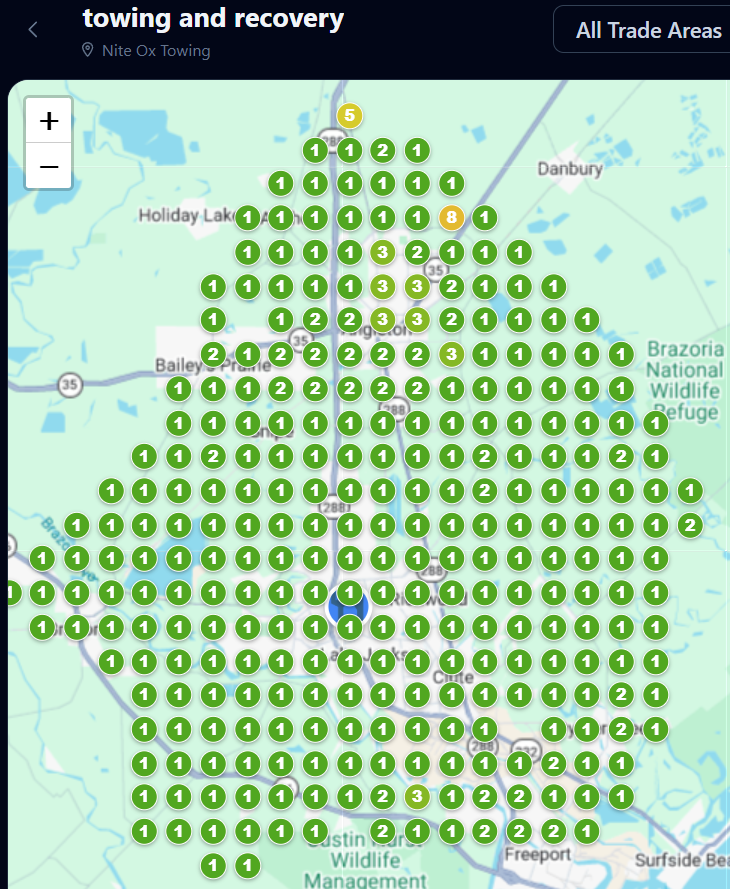
3×
Ariel's Towing & Recovery, Lake Jackson
Call volume tripled after Google Business Profile optimization, citation cleanup, and a rebuilt local content structure. See the full case study →
The pattern held for a very different kind of business, too. For Nature Pure Life, an e-commerce skincare brand, the same fundamentals — clean site structure, targeted content, and consistent signals — produced a 28% increase in organic traffic and a 19% increase in sales. The channel changes; the underlying mechanics of what Google trusts don't.
"The businesses that don't see results are usually the ones that start and stop — optimize the profile once, publish two blog posts, then go quiet. Local search compounds when the effort is consistent, and it stalls the moment it isn't." — Frank Jones, SEO My Website Guru
Your Google Business Profile Is the Foundation
If you do nothing else, claim and fully optimize your Google Business Profile (GBP). It's free, it's the single highest-leverage lever for Map Pack visibility, and most small businesses in Brazoria County and the Houston metro have left it half-finished.
- Primary and secondary categories
— set as specifically as your business allows, not just the broadest match
- Complete services and business description
— written in the language customers actually search, not internal jargon
- Photos, updated regularly
— profiles with recent photo activity outperform static ones
- Questions & Answers section
— seeded proactively rather than left for competitors to fill
- Consistent posting activity
— an active profile signals a real, operating business
We cover the step-by-step process in a separate guide: I Claimed My GBP — What Are the Next Steps?
Citation Consistency: The Signal Most Businesses Get Wrong
A citation is any mention of your business's name, address, and phone number (NAP) online — Google, Yelp, Facebook, the Better Business Bureau, industry-specific directories, and dozens of data aggregators most business owners have never heard of. Google cross-references these listings to confirm your business is legitimate and located where you say it is.
The problem is almost never a lack of citations — it's inconsistency. An old address on one directory, a disconnected phone number on another, a business name that's slightly different across five listings. Each inconsistency chips away at Google's confidence, and that shows up as suppressed Map Pack rankings even when everything else looks fine. Citation cleanup is one of the first things we audit for every new client, and it's often the fastest win available.
Reviews and Reputation Signals
Review count matters, but review velocity — how recently you've earned reviews — matters more than most business owners realize. A business with a dozen reviews in the past 90 days will often outrank a competitor sitting on eighty reviews that stopped coming in three years ago. Google reads recent activity as evidence the business is still operating and still earning trust.
The mechanics are simple even when the discipline isn't: ask every satisfied customer for a review immediately after the job, make it a one-tap process with a direct link, and respond to every review — good or bad — professionally. Reputation management is part of what we handle for ongoing clients, precisely because it's the piece that gets dropped first when a business gets busy.
What Your Website Needs to Contribute
A Google Business Profile alone can rank in the Map Pack, but a weak website holds back even a strong one — and it leaves organic rankings, where the other 7 results on the page live, almost entirely uncaptured. Three things matter most on the website side:
Dedicated Service Pages
Every core service needs its own page built around how people actually search for it, not a single generic "Services" page trying to cover everything. Each page should name the service, the city and nearby service areas, and include enough specific content — generally 400 to 600 words — to signal real expertise rather than a template.
Location-Specific Content
Geo-anchored pages for the individual cities and suburbs a business actually serves consistently outperform a single "service area" paragraph buried on the homepage. This is the structure behind our own Houston metro
and Brazoria County city pages, and it's the same architecture we build for local service clients.
Mobile Speed
Most local searches happen on a phone, often while someone is standing in front of the problem they need solved. A site that takes more than a few seconds to load loses a meaningful share of that traffic before it ever sees the page, and Google factors load speed into ranking. SEO-optimized web design
that's fast and mobile-first isn't a nice-to-have for local search — it's a prerequisite.
Beyond Google: Where Else Local Search Happens
Google Maps dominates local search, but it isn't the only place a business's information gets surfaced. Apple Maps, Siri, in-car navigation systems, and — increasingly — AI answer engines like ChatGPT, Perplexity, and Google's own AI Overviews all pull from the same underlying pool of business data and web content. A business with accurate, consistent data and well-structured local content is positioned to get picked up across all of them, not just the traditional Map Pack.
This is a newer front and most competitors haven't built for it yet. We've already confirmed citations for our own market in Google's AI Overview for searches like "seo near me lake jackson tx," which shows the same fundamentals — clear content, consistent signals, real local specificity — extend into how AI systems decide who to recommend, not just how Google's classic algorithm ranks pages.
What to Realistically Expect, and When
Local search optimization is not instant, and any agency that promises a top-three Map Pack ranking in a week is not being straight with you. What's realistic:
- 0–30 days:
Google Business Profile optimization is complete, citation cleanup is underway, and early signals (impressions, GBP actions like calls and direction requests) start moving
- 30–60 days:
Most clients see their first measurable ranking improvements, particularly for less competitive local terms
- 3–6 months:
Meaningful, compounding gains in Map Pack position and consistent lead flow, assuming the work stays consistent
The timeline shifts based on how competitive your specific market and category are and how far behind the starting point is — a business with no GBP claimed and inconsistent citations everywhere takes longer to turn around than one that's 80% of the way there already. Either way, this is also why we work on a no-contract, 30-Day Guarantee
basis: you should be able to see the early signals for yourself before committing to anything longer.
Common Questions About Local Search Optimization
What's the difference between the Map Pack and organic search results?
The Map Pack is the block of three local listings with a map, shown above the standard organic results for location-based searches. It's ranked using local-specific signals — your Google Business Profile, citations, and reviews — while organic rankings depend more heavily on your website's content and authority. A strong local search strategy addresses both.
Do I need a website to rank in the Map Pack?
Not technically — a Google Business Profile alone can appear in the Map Pack. But a well-built, fast, mobile-friendly website consistently outperforms a GBP-only presence, both for Map Pack rankings and for converting the traffic once someone finds you.
How long does local search optimization take to show results?
Most clients see early movement — impressions, GBP actions, initial ranking shifts — within 30 to 60 days, especially after Google Business Profile optimization. Meaningful, compounding gains typically build over three to six months, depending on how competitive the market is and where the business is starting from.
What are local citations and why do they matter?
A citation is any online mention of your business name, address, and phone number — on Google, Yelp, the BBB, industry directories, and data aggregators. Google cross-references these to verify your business is legitimate and located where you say it is. Inconsistent information across listings is one of the most common, and most fixable, reasons a business underperforms in local search.
Why work with a solo SEO operator instead of a larger agency?
A larger agency often means your account gets handed to whichever team member has bandwidth that month. Working directly with one person means the strategy, the execution, and the accountability sit in the same place — and it's part of why we operate with no contracts and a 30-Day Guarantee instead of asking businesses to commit before they've seen results.
Ready to Show Up in the Map Pack?
No contracts. Measurable progress in 30 days — guaranteed.
Serving Brazoria County and the Greater Houston metro.
See Our Local SEO Services →
Ready to talk? Get in touch →
About the Author
Frank Jones
is the owner and SEO strategist behind SEO My Website Guru, based in Brazoria, TX. He's worked in web and search since the internet's earliest days and works directly with every client — no account handoffs, no contracts.